
| Principal & Designated Safeguarding Lead | |||
|---|---|---|---|

Sarah Osborne |
|||
| Deputy Designated Safeguarding Leads (DSLs) | |||
 
Ingrid Spencer Vice Principal |

Vicky Bland Assistant Principal |

Sally Bott Assistant Principal |

Sammy Nour Assistant Principal |
| Governors with Responsibility for Safeguarding | |||
| Sonia Barnes
Lead Councillor |
|||
Angela James & Helen Dhillon
Safeguarding Councillors
If you have any concerns regarding the safety or welfare of one of our pupils, or would like further guidance about keeping yourself or your children safe online, please do not hesitate to contact one of the Safeguarding Leads (above)
You can contact any of the safeguarding team through the school office either via email; [email protected] or on 0116 2415921.
For Safeguarding concerns or advice during holidays, please contact Leicester City Council’s Children’s Social Care on 0116 454 1004 or you can talk to a member of our Safeguarding team on 07549084022.
If you have a concern about a member of staff, speak to the Principal.
If you have a concern about the Principal, you can contact the TMET CEO, Sarah Ridley by email [email protected]
Concerns about any child can be reported to Leicester’s safeguarding board on 0116 4541004. This is a 24 hour number.
NSPCC Whistleblowing Advice Line:
Support for professionals who are worried about children in the workplace 0800 0280285, [email protected]
Our UNIQUE Values and the Culture of Safeguarding at Oaklands
| Value | Description |
|---|---|
| Understanding | Being professionally curious so we understand each child’s unique safeguarding needs, removing barriers and providing support that pupils may need relating to the four areas of abuse and the context of our school community. |
| Nurture | Nurturing progress through a curriculum that supports pupils to keep themselves safe in school, the wider community and online. |
| Interaction & Communication | Providing safe interactions with pupils, supporting their welfare and wellbeing by enabling them to feel safe to make a disclosure or seek adult support, and communicating any concerns in a timely manner with DSLs. |
| Quality | Having high-quality training and safeguarding conversations between staff and with other services, ensuring that all staff understand their safeguarding role and that policies and procedures are proactive and reflective. |
| Us | All staff and Governors being aware that safeguarding is everyone’s responsibility, including promoting a culture of safer recruitment. |
| Engagement | Working with children, parents/carers, safeguarding partners and other services to protect children, acting to prevent the impairment of children’s mental and physical health or development. |
What is Safeguarding?
Safeguarding is the action that is taken to promote the welfare of children and protect them from harm. The Government has defined the term Safeguarding children as
‘The process of protecting children from abuse or neglect, preventing impairment of their health and development, and ensuring they are growing up in circumstances consistent with the provision of safe and effective care that enables children to have optimum life chances and enter adulthood successfully.’
At Oaklands, we are committed to safeguarding and promoting the welfare of all our children. We ensure this happens through:
- Establishing, implementing and following good safeguarding policies and procedures including safe recruitment
- Ensuring all staff and volunteers are aware of, understand and follow the school’s safeguarding policies and procedures
- Ensuring that all staff and volunteers receive child protection training
Anyone working with the children at Oaklands is advised to maintain an attitude of ‘it could happen here’ where safeguarding is concerned. When concerned about the welfare of a child, we will always act in the interests of the child.
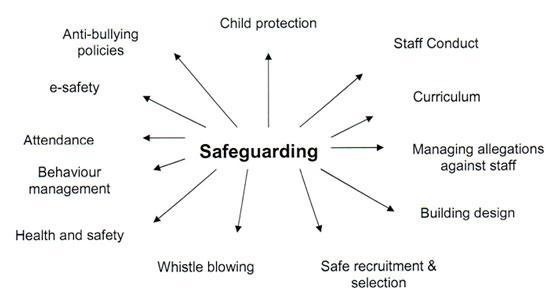
There are many aspects of Safeguarding;
How do we keep children safe?
‘Our school/establishment ensures children learn in a safe, caring and enriching environment. Children are taught how to keep themselves safe, on and off line, to develop positive and healthy relationships and how to avoid situations where they might be at risk including by being exploited’.
Our school has a statutory responsibility to share any concerns it might have about a child in need of protection with other agencies and in particular police, health and children’s services. Schools are not able to investigate concerns but have a legal duty to refer them. In most instances, the school will be able to inform the parents/carer of its need to make a referral. However, sometimes the school is advised by Children’s Social Care or police that the parent/carer cannot be informed whilst they investigate the matter. We understand the anxiety parents/carers understandably feel when they are not told about any concerns from the outset. The school follows legislation that aims to act in the best interests of the child’.
Our Staff are all trained to be alert to Safeguarding issues.
What do staff at Oaklands do if a child makes a disclosure?
- Listen to what is being said without displaying shock or disbelief
- Accept what is being said
- Allow the child time to talk freely
- Reassure the child that it is right to tell
- Do not ask leading questions or investigate concerns further
- Don’t promise to keep it a secret. Explain to them that you have to tell someone in order that you can help
- Report any concerns immediately afterwards to the Designated Safeguarding Lead
- Record all information as soon as it is possible
- Only share information with the Designated Safeguarding Lead
- If the concern is about the conduct of a member of staff, they will contact a Designated Safeguarding Lead. If the concern is about the Principal, they would inform the lead councillor – Sonia Barnes.
At times, it may be necessary for a Designated Safeguarding Lead to call the child’s parents or carers to discuss briefly what a child has said, or what a member of staff has noticed, and this may immediately help us to clarify what has happened. This is a requirement of the school. We will always undertake to share our intention to refer a child to Children’s Social Care with their parents/carers consent unless to do so could put the child at greater risk of harm, or impede a criminal investigation. If in doubt, we will consult with Children’s Social Care; CASP Children’s Advice, Support & Prevention Team.
NMA TMET Safeguarding and Child Protection Policy
Advice is available from the NSPCC online – click the link below
What is Early Help?
Early Help means providing help for children, young people and families as soon as problems start to emerge or where it is likely that issues will impact negatively on outcomes for children.
Early Help…
- Is for children of all ages and not just the very young,
- Can be very effective in supporting a child, young person and/or their family to step down from statutory services as well as preventing issues from escalating.
Is important because there is clear evidence that it results in better outcomes for children.
Early Help in Leicester
The vision in Leicester is to improve children’s lives by working in partnership to raise aspirations, build achievement and protect the most vulnerable. This is based on the belief that:
Children, young people and families develop resilience if there are protective factors in place such as: a positive relationship with an adult; good literacy and communication skills; good school attendance; and parents in or actively seeking/ready for work
Children’s needs are best met when help is offered in a universal setting within a socially mixed group and early on when problems start to emerge
Children and young people’s needs are best met when addressed in the context of the whole family, meaning that parents/carers/siblings’ needs are addressed with consent as part of a holistic and integrated Early Help response
Early help services should support and strengthen families so that they can thrive.
The Role of Schools
Day to Day Support: Most families, most of the time, can get on with their lives quite happily with little or no outside help. If they need help it is usually provided by universal services, such as schools.
Focused Pastoral Support: All families can have times, however, when difficulties arise, and they either may not recognise it or may not know how to start putting things right. Schools play a role in supporting families to address these difficulties through more focused pastoral support, which might include bringing in support via an external agency.
Early Help Assessment: For those children and families whose needs and circumstances make them more vulnerable, or where schools need the support of other agencies to meet the needs of the family, a coordinated multi-agency approach is usually best. In Leicester this is achieved through undertaking an Early Help Assessment and assigning a Lead Practitioner to work closely with the family to ensure they receive the support they require. Schools should be a key partner in any multi-agency work to support families.
Early Help at Oaklands
Oaklands recognises that early intervention can have a positive impact for our families and can prevent children from significant harm. Therefore, Oaklands promotes an Early Help Offer which is aimed at providing support at the appropriate and earliest level.
Here at Oaklands, we understand just how complicated family life can be. From time to time there may be situations where you need extra help and support. There are many ways in which we can help!
Taking the time to listen to children’s concerns.
Taking the time to listen to families. Sometimes, you might need to share information or have a difficult situation you need to make us aware of. We will listen. We have families too!
We have an effective curriculum which focusses on children’s lives and their community, this helps support children and develop key skills not only for school but for life.
We run parenting courses. These aren’t sessions to tell you how to do it, but an opportunity to share what works and sometimes what doesn’t!
We have a school nurse. You can speak directly with the school nurse team or we can refer you as a school.
There are social workers who we can contact to try to find the right kind of support for you.
There are a number of support agencies out there who we can access or signpost you to if you are experiencing difficulties at home.
There are also agencies which you can contact independently should you wish to do so, who might be able to help and provide the support for your family.
Below is a list of how we aim to support our families initially with issues that may arise. Where these issues continue to be a concern, the school will discuss an early help referral with families for extra support.
| Area | Your Offer | Measurable Outcomes |
|---|---|---|
| Attendance | • Attendance data monitored • Attendance Officers • EWO (Educational Welfare Officers) • EWO meetings (Attendance Panels, penalty notices, PACE meetings, court) • Behaviour Lead / Mental Health Champion • First day calling • Home visits • Letters home • Meet and greets • Monitoring of leave of absence requests • Panel meetings • Personal attendance plans • Policy for leave of absence requests • Regular monitoring • School nurse (where there’s a medical condition) |
• Overall and individual pupil attendance improves • Improvement in Persistent Absence (PA) data • Reduction in leave of absence requests • Reduction in penalty notices issued • Improved lateness data • Whole-school attendance targets met • Short-term improvement in attendance of Persistent Absence (PA) pupils |
| Area | Your Offer | Measurable Outcomes |
|---|---|---|
| Transition | • Books / photos • Extra visits / induction • Health visitors / School Nurse • Home visits • Induction sessions • Link between educational phases • Nursery / Home visits • Stay & Play sessions throughout the year • Coffee morning for new parents • Pupil profiles • SALT (Speech and Language Therapists) • SEMH Team (Social, Emotional & Mental Health) • LCI Team (Learning, Communication & Interaction) • Social stories • Teacher meetings between pathways and class groups • Visits for prospective families • Visits to feeder schools • Support families with appeals |
•pupils are adequately supported upon entry • Pupils obtain a place at their chosen school • Family needs are met whilst awaiting placements |
| Area | Your Offer | Measurable Outcomes |
|---|---|---|
| SEMH | • Behaviour Lead • CAMHS (Children, Adolescent Mental Health Service) • Drawing and Talking Therapy • Educational Psychologist • Oakey Boost • Zones – Pupil self-regulation tool • Lego Therapy • Arts, Sports & Hobbies (ASH) • Meet and greet • Targeted interventions • Pastoral Support Programme • Play interaction • Positive Behaviour Support Plans • Positive Behaviour Handling Plans • School Nurse • SEMH Team (Social, Emotional & Mental Health) • LCI Team (Learning, Communication & Interaction) • Staff training in SEMH & behaviour support • Team Teach / Positive Handling training • Virtual School Team • CPOMS tracking > targeted support • Drama Therapist • Occupational Therapist • Music Therapist |
• Pupil learning data shows improvement • Reduction in number of high / low-level behaviour incidents • Increase in pupils’ self-help skills • Reduction in fixed-term exclusions • Reduction in physical interventions • Assessments show that emotional needs are met and progress is made |
| Area | Your Offer | Measurable Outcomes |
|---|---|---|
| Staying Safe | • Advice point – signpost to Surestart • Assemblies • Care plans • 5 trained DSLs • 3 trained Team Teach trainers • Data protection procedures • Early Help offer • E-safety • External advice • Home visits • Link Police Community Support Officer • Mental Health Champion • Monitoring of leave or absence requests • Parent workshops • Behaviour Lead • PEP/LAC meetings • Prevent Training • Safeguarding workshops e.g. FGM (Female Genital Mutilation) / Forced Marriages, CUSAB • Safer recruitment procedures • School nurse referrals • School nurse drop-in sessions • Early Help Referrals • So Safe • Curriculum Days • Tracking of incidents through CPOMS • Whole school safeguarding training • Use Neglect Toolkit |
• Increase in turnover of families accessing Social Services / Family Support Worker / Early Help • Welfare and neglect issues on Social Services caseload is reduced • An increasing percentage of parental engagement • An up-to-date rolling programme of CPD (Continued Professional Development) in relation to Safeguarding / Training for all staff |
| Area | Your Offer | Measurable Outcomes |
|---|---|---|
| Supporting Families | • Open door policy / phone calls • Family Link / Support Worker, outside agencies e.g. School Nurse, Police, EWO • Fill out forms • Financial support through Pupil Premium • Home visits • Housing applications, DLA – letter of support • Workshops / training programmes for parents • Newsletters • Parents evenings • EHCP meetings • SENDIASS (Special Educational Needs and Disabilities Information Advice Support Service) • Signposting to external agencies • Signposting to training • Early Help • Attendance procedures |
• Pupil learning data shows improvement • Uptake of support services increases • Reduction in number of DNAs (Did Not Attend) to appointments and meetings • An increasing percentage of parental engagement |
| Area | Your Offer | Measurable Outcomes |
|---|---|---|
| The Local Community | • Governors • Link PCSO • Link with Fire Services • Links between schools – school-to-school support / collaboration • Links with community groups • Links with local businesses • Religious groups • Supporting charities |
• Families have a better understanding of the wider community • Pupils understand their place in the wider community |
| Area | Your Offer | Measurable Outcomes |
|---|---|---|
| Curriculum | • TEACCH Work • 1:1 support • Group work • Arts, Sports & Hobbies activities • Curriculum Days • Visitors invited into school • Sensory Rooms & Garden • Forest School • Soft Play • Life Skills • Interventions • Integration to mainstream primary school • Assemblies • Inter-school events • Outside agencies • PSHE • Regular school trips (subsidised for PP) |
• Pupil learning data shows improvement |
Please contact one of our Designated Safeguarding Leads at Oaklands if you would like further information about Early Help: Sarah Osborne, Ingrid Spencer, Sally Bott, Vicky Bland and Sammy Nour on 01162415921.
Family Support
My name is Mala Chohan. I am introducing myself as Oaklands’ Family Support Worker. I do hope that I will be able to meet you on site at some point soon. I have met many of your wonderful children and am excited to continue to work at Oaklands.
My role is to offer ongoing support to families and establishing a safe and stable environment for children. I provide one-to-one support to families at Oaklands, such as information on accessing support for children with a disability and/or special educational needs, signposting families to various local services, support with language barriers that perhaps is preventing you from accessing services. These are just a few examples of how I can support families, please pop by to see me if you would like to have a chat. The support is free to access for all families.
I have an office in school that is situated near the office/reception area, alternatively I am happy to arrange to come and see you at your home if that is more convenient for you.
If you would like to call me at the school or you can email me at [email protected] I am available on Monday, Tuesday, Wednesday and Thursday from 10am – 2pm and on a Friday from 10am -1pm.
Mental Health
Mental health is about how we think, feel and behave. One in four people in the UK has a mental health problem at some point, which can affect their daily life, relationships or physical health. One or two in every 100 people will experience a more severe mental illness such as schizophrenia or bipolar disorder.
NHS Direct Wales, 2019
Growing up is never easy and, for children with SEND particularly, there are many things that can trigger mental ill health.
Risk factors;
As with all situations, there are certain factors that may increase risks of poor mental health
- Parental issues (e.g. substance/alcohol abuse, mental health issues, parent in prison)
- Loss within the family (e.g. parents who separate or divorce, bereavement)
- Experience of abuse (physical, sexual or emotional) or neglect
- Experience of being severely bullied
- Living in poverty or experiencing homelessness
- Being a young carer
- Experiencing significant issues at school
Although autism is not a mental health condition, around 70-80% of children (Simonoff, E. et al 2008) and autistic adults (Lever, A.G., Geurts, H.M., 2016) have experienced mental health problems. Many young autistic people felt that these problems stemmed from the pressure to act ‘normal’ in a neurotypical (non-autistic) world.
Useful sources of information about mental health;
Mental health in young autistic people (autism.org.uk)
YoungMinds | Mental Health Charity For Children And Young People | YoungMinds
Anna Freud National Centre for Children and Families
Anna Freud National Centre for Children and Families
Online Safety
“Today’s children and young people are growing up in an increasingly complex world and living their lives seamlessly on and offline. This presents many positive and exciting opportunities, but also challenges and risks. In this environment, children and young people need to know how to be safe and healthy, and how to manage their academic, personal and social lives in a positive way.” (RSE Statutory guidance 2019)
Internet safety is a big concern for all parents and families and so within our PSHE curriculum we have a clearly identified rolling programme of E-Safety teaching; teaching staff will also use instances where children refer to dangerous online behaviour to contextualise learning in the moment. We also aim to support parents/carers to keep their child safe online at home by providing a range of up to date information through newsletters and our social media platforms, such as class dojo. In this way, the school will be able to work with parents/carers to support every child’s learning about online safety.
Support for families to keep children safe online
Explore together: Explore online together so you can share all the great fun and educational things they can do. Remind them if anything makes them sad or frightened to come and show you.
Be involved: Ask children to use devices in the same room as you, it’s easier to keep and an eye on how they’re using the internet. Ask them to share their interests with you.
Put yourself in control: Use parental controls on your home broadband and internet-connected devices. Talk to your child about keeping safe and not telling people names (or other details) online.
Search safely: If you let your child search online, make sure safe search settings are on for Google and other search engines or use search engines for children such as: https://www.safesearchkids.com/kids-search-engine/
https://swiggle.org.uk/
https://www.kiddle.co/
https://kidinfo.com/
Use passwords: Keep devices out of reach (for younger children) and always set passwords on all your internet-connected devices. This is the easiest way to know when they are using the internet. Passwords also stop additional purchases when they’re playing games or using apps.
Visit e.g. www.internetmatters.org to find out how.
Use age-appropriate sites and apps: Choose safe, fun and educational sites and apps for your child, use video, learning, gaming platforms and services designed with children in mind like YouTube Kids, Sky Kids, BBC iPlayerKids, and Nick Jr
For more advice click –
www.internetmatters.org Top kids TV apps for safer viewing
Set boundaries: Set some rules about how they use internet-connected devices including which apps and sites they can use and how long they can spend on them. Use timers to limit the time on a device or show the time is about to finish. Make sure they know what the next activity will be. Avoid using devices in the hour before bedtime. This is good advice for all of us!
Advice from NSPCC for families with children who have SEND
- Parents are best placed to know their child – This is particularly true for children with SEND. We recommend parents consider the right age and stage for their child based off the level of support they need.
- Make use of tech to support – We know tech can be vital for communication, learning and sensory or emotional regulation for children with special educational needs. It’s important that children continue to receive access that is right for them.
- Explore all relevant strategies – While age-based recommendations may not be appropriate they can instead be approached as a list of practical strategies for parents to explore.
- Use resources tailored to children with SEND – We worked with Ambitious about Autism to create tailored advice and resources for parents to use with their children.
Other useful websites:
Childline Taking control of your online safety | Childline
NSPCC Keeping children safe online | NSPCC
Uk Safer Internet Centre Parents and Carers – UK Safer Internet Centre
CEOP Home safety activities Online Safety Family Activities (thinkuknow.co.uk)
Childnet Parents & carers | Childnet
Parents’ Ultimate Guide to TikTok (Commonsense Media)
TikTok app safety – What parents need to know (Internet Matters
Online Safety and Sexual Abuse or Harassment
Are you worried about online sexual abuse or the way someone has been communicating with you online?
શું તમે ઑનલાઇન લૈંગિક દુર્વ્યવહાર અથવા તમારી સાથે કોઈ ઑનલાઇન વાતચીત કરી રહ્યાં છે તેના વિશે ચિંતા કરો છો? અહેવાલ આપવા માટે અહીં ક્લિક કરો. (Gujarati)
Ma ka werwersantahay dhibaataynta galmada ee onlaynka ah ama qof kula hadlaya khadka? Riix halkan si aad uga warbixiso (Somali)
Martwisz się molestowaniem seksualnym online lub kimś kto rozmawia z Tobą online? Kliknij tutaj, aby zgłosić. (Polish)
Use this button to Report abuse online

It can be scary finding out that a nude image or video has been shared online. Childline can help remove a nude image shared online. Click on the picture below for help with what to do:

OPERATION ENCOMPASS
Since 2018 all Leicester Schools have become part of a new safeguarding initiative which aims to improve outcomes for children and families affected by domestic violence and abuse.
The initiative, ‘Operation Encompass’, is run in partnership with Leicester City Council and Leicestershire Police and has been designed to provide early reporting to schools of any domestic abuse incidents that might have an impact on a child at their school.
During the school term, Sarah Naylor, Principal and Designated Safeguarding Lead, will now be informed when any domestic abuse incident has been reported to the police and a pupil of Netherhall Mead Academy was in the household. Details about the incident will NOT be provided.
We will use the information to ensure the school is able to provide appropriate support to our pupils. The information will remain CONFIDENTIAL and will only be shared on a strictly need-to-know basis, for example with the class teacher.
We know domestic abuse in a household can have a big impact on families. If you would like to speak to someone in confidence about domestic abuse, call the Leicester, Leicestershire& Rutland Domestic Abuse Helpline on 0800 802 0028 or visit https://www.leicester.gov.uk/your-community/emergencies-safety-and-crime/domestic-and-sexual-abuse/
If you have any questions or would like to discuss this further, please speak to Sarah Naylor, Principal on 0116 2417258.
Operation Encompass Letter to parents

Local support:
Housing and homelessness support for domestic abuse (leicester.gov.uk)
FreeVA Support – Free from Violence & Abuse
National helplines:
Domestic Violence Assist | DV ASSIST
Home – Women’s Aid (womensaid.org.uk)
Domestic Abuse Helpline for Men | Men’s Advice Line UK (mensadviceline.org.uk)
 Building Foundations for Fulfilling Futures