Oaklands – the ‘Inside-Outside’ school
Oaklands School is a very special place; from the majestic oak tree outside the school building to the spinney at the back, it is full of nature, open spaces, and opportunities to learn. Our school building is unusual: the older part of the building is built in a square with a garden and playground at the centre whilst the new part of the building offers eight additional classes over two areas all with their own break out space. This ‘inside-outside’ aspect of the school building perfectly reflects the ‘inside-outside ‘way of living and learning at Oaklands for every member of our community, whether staff, parent or child.
At Oaklands School, we believe that our curriculum should be rich, creative and challenging in order to engage and motivate our children. The Oaklands curriculum offer comprises all learning and other experiences that we plan for our pupils and is both explicitly taught and embedded in our practices and environment. We strive to provide the highest quality opportunities for all of our unique children to achieve meaningful progress in a broad range of skills from their own starting points.
We have four pathways; Nurture, Willow, Elm and Cherry. Children are placed into these pathways based predominantly on their communication and interaction levels. Oaklands curriculum is broken down into seven Areas of Learning which are studied by the majority of pupils; however, those in our Nurture Pathway have a bespoke curriculum focusing on the Engagement Model’s five areas of engagement.
The majority of pupils have a diagnosis of ASD (Autistic Spectrum Disorder) and all have communication and interaction difficulties, which can mean the wider world is a very over-stimulating, confusing and challenging place to be. Our classrooms and whole school fabric are therefore controlled and calm, a low-arousal space to enable our children to relax and become more open to learning. In order to ensure that our children have firm foundations in learning when they leave us, we have developed a rigorous approach to planning and sequencing learning, supported and informed by our own ipsative assessment system.
Our Areas of Learning and related assessment frameworks are as follows:
| Areas of Learning | Related assessment including OPAL ladders |
|---|---|
| Communication, Interaction & Social Skills |
|
| Emotional Regulation & Wellbeing |
|
| Physical Development |
|
| Independence & Life Skills |
|
| Literacy |
|
| Mathematics |
|
| Science & Environmental Education and Creativity & the Arts (includes RE) |
|
If you would like more information regarding our curriculum please contact our Deputy Head.
The school understands the role it must play in preparing children for autonomy, independence, and adulthood. Their vision is “Building foundations for fulfilling futures” and their ‘inside out’ curriculum is focused on children learning about themselves ‘inside’, others and their environments ‘outside’ so that they can be fully prepared to become members of the community and to flourish within this. The school is the only National Autistic Society Advanced Accredited School in Leicester.
Inclusion Quality Mark Review May 2024
Educational progress is, at the most basic level, the difference a school makes to any pupil from admission to leaving that school. There are many ways to measure progress, including comparison to similar pupils/ cohorts locally and nationally. However, each Oaklands’ child is so unique in their spiky profile of strengths & areas of development, and our total cohort size is small, therefore comparative data is not statistically valid or particularly useful in assessing the quality of our provision or pupil progress.
At Oaklands, we use our own bespoke assessment system with OPAL (Oaklands Progressive Assessment Ladders) for pupils in Willow, Elm & Nurture pathways, and OPEAL Oaklands Progressive Engagement Assessment Ladders) in Nurture as they are pupils working within the Engagement Model of Learning. As each child at Oaklands is unique, the I can statements in OPAL & OPEAL track their individual journey from their own starting points (baseline) so that we can see progress at an individual level measured in number of steps achieved. There is also a horizontal measure of progress (APS) within a single step to capture the progress made by students with the most severe learning difficulties, from Accessing a skill, to Practicing it, to having multiple scaffolded and more independent attempts to Secure that skill.
Within OPAL, there are 7 ladders of micro steps within larger skills and knowledge blocks that relate to the 6 assessed Areas of Learning (AOL) within the Oaklands curriculum:
- Literacy
- Maths
- Emotional Regulation & Wellbeing
- Physical Development
- Communication, Interaction & Social Skills (2 ladders)
- Independence & Life Skills
There are two further Areas of Learning which are not assessed:
- Science & Environmental Education
- Creativity & the Arts
Within OPEAL, the 5 ladders use the Engagement Model areas: Exploration; Realisation; Anticipation; Persistence & Initiation as their focus with small steps identified to track early learning behaviours and skills.
OPAL & OPEAL ladders provide staff with a very broad and comprehensive set of competency-based criteria which gives a rounded view of all pupils’ strengths. Staff use the OPAL & OPEAL statements continually to formatively assess pupils and adjust their provision to meet needs and enable them to achieve their next steps. Each child’s set of ladders are regularly updated and are a good source of understanding about pupils’ strengths and areas of development. Recording is done on paper so anyone can access the records to inform their practice and focus on pupils’ next steps. In this way, we can also regularly share information about aspects of a child’s learning with parents/carers.
Judgements of progress are moderated within class teams, as well as across the school. In regular Progress Review Meetings, class teachers’ feedback to their line manager on general progress, areas where their children or key individuals may be struggling, and report on the impact of Resilience Building Plans. Collaboratively, the line manager and teacher look at ways to bridge the gap for learners who have specific areas of need, and school leaders look for any commonalities that could be addressed more widely. Due to the heterogeneity of our cohort, even within the same pathway, comparison of progress or a notion of ‘expected progress’ are not meaningful at Oaklands. Therefore, we do not draw cohort comparisons but do ensure that every child’s progress is discussed regularly over the year. Leaders ensure that all staff are aware of particular vulnerabilities that may impact upon an individual’s learning, such as economic disadvantage.
Class teacher reports at the end of the year and before annual review meetings offer a rounded view of pupil progress in addition to data on OPAL or OPEAL steps achieved. A child’s library of reports is evidence of progress over time, and supported by half termly video assessments.
Other Views of Outcomes for Learners: As well as our own internal processes to ensure that we are maximising progress for learners, there are many other ways in which we check that outcomes for our learners are good or better. One of the ways is by getting parent/ feedback through Annual Review meetings and parent surveys. Parent/carer satisfaction is very high with regular feedback that 95%+ Agree strongly or Agree (or equivalent) on key questions such as ‘My child likes going to school’ and ‘The school informs me about my child’s learning and progress’. In May 2023, 92% of parents surveyed told us that they think their child is making good progress considering their special educational needs. Parent/carers are also asked to feedback at Annual Review meetings regarding progress towards their child’s EHCP objectives (OPAL related Statements). In addition, we regularly seek feedback from the secondary schools that our pupils’ transition to about how prepared and ready they are for their next steps in education. Secondary school leaders unanimously tell us that pupils are effectively prepared for the transition and have built firm foundations on which to continue their education.
Long Term Outcomes: We know that in exceptional cases, some pupils in the past have gone on to sit GCSEs, Entry Level accreditations, step up to English and Maths courses or attend colleges to study courses such as Bricklaying or Catering. The majority of pupils access personalised learning based on EHCP outcomes including travel training & preparing for adulthood.
’The curriculum has been extremely well planned and developed over time. Pupils are carefully placed in one of the four curriculum pathways according to their communication and interaction needs. This includes the youngest children in the early years foundation stage. Leaders and staff work highly effectively in teams to continually develop and refine the curriculum content.’
Ofsted Report February 2024
Promoting Fundamental Human Values.
In accordance with The Department for Education we aim to actively promote Human values in schools to ensure young people leave school prepared for life in modern Britain. Pupils are encouraged to regard people of all faiths, races and cultures with respect and tolerance and understand that while different people may hold different views about what is ‘right’ and ‘wrong’, all people living in England are subject to its law. The Key Values are:
- Democracy
- rule of law
- individual liberty
- mutual respect
- tolerance of those of different faiths and beliefs
Meta-Cognition and Learning Powers
Building learning powers is based on the idea that we are all capable of becoming better learners and that through this we can help our pupils secure skills and characteristics that will prepare them for adulthood.
“To thrive in the 21st Century, it’s not enough to leave…. with examination certificates. You have to have learnt how to be tenacious and resourceful, imaginative and logical, self-disciplined and self-aware, collaborative and inquisitive” Claxton 2002.
Key principles of Building Learning Powers:
- Creating a learning culture that encourages children and teachers to become better learners
- To allow children to approach difficulties in learning without fear of failure
- To allow children to take small steps within learning
- To develop confidence
- This is not additional to teaching but should be grounded within everyday teaching and learning
- To have shared key words for the children and staff to develop understanding of learning processes
Our school has developed a language for learning through the use of meta-cognition. This has involved creating and developing an ethos, atmosphere and language of learning throughout the school. Meta-Cognition allows us to teach pupils how to deepen their understanding by encouraging them to think and communicate even more about their learning. Teaching our pupils to practice the learning powers allows them to develop the capacity to learn in challenging circumstances throughout school and wider life, maximising success. Our learning powers support the teaching of meta-cognitive skills throughout the school.
Learning Powers at Oaklands
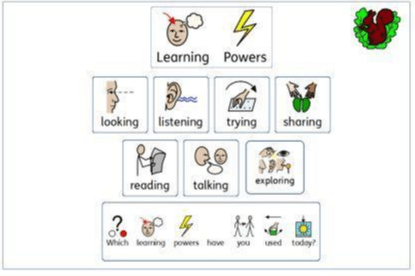
Looking:
Being attentive and able to pay attention to teaching in class, but also learning to be more aware of their surroundings, including people and objects. Looking may be for short periods of time, with minimal or no eye contact as we know people with ASD can struggle with this, and also include sensory breaks, e.g. getting up to walk or stim then returning to looking at the teaching or focusing on the learning task.
Listening:
Developing listening skills in a range of contexts. Listening to instructions from school staff is extremely important, as well as being able to understand teaching. We ensure we are using language and sentence length appropriate to individual students to maximise understanding, e.g. using key words for our more complex learners, working up to longer sentences as they develop their listening skills and understanding.
Listening also includes being able to discriminate sounds in the environment, which in turn helps to develop understanding of phonics and spoken language.
Trying:
Trying is all about continuing to try something, even when you’re facing difficulty, failure or some delay. Research shows that it is important to praise children on their efforts over their intellect (Dweck, 2007), e.g. praise with ‘great effort!’ rather than ‘clever boy/girl!’. We ensure learning for our students is a ‘healthy challenge’ that meets their ability level, so trying is required and praised appropriately.
Resilience is broader. It’s about overcoming negative circumstances or adversity in your life, handling your emotions, and still remaining healthy and competent.
Sharing:
This can be applied to a variety of contexts, including sharing resources, space or an interaction with another student of member of staff. It is important that students learn to share these things, doing so at their own pace.
Reading:
Reading applies to a variety of situations, linked to our Three World of Reading teaching as part of our Literacy Curriculum. The first is Reading the World, the second Reading the World of School and Community, and the third is Reading the World of Words and Books. Each World of Reading is equally important and individual learners will be accessing different worlds.
Talking:
We are referring to all forms of expressive communication as ‘talking’. Many of our students are pre-verbal so their expressive communication will be through signing, PECS, communication books or using gestures, all of which are valid forms of communication and to be praised.
Exploring:
Exploring is an important aspect of learning for our students, whether it’s exploring a new activity or resource, or physical place, and will look different for individual students. We encourage exploring in all forms and incorporate it into learning in school.
What is Positive Behaviour Support (PBS)?
Positive Behavioural Support (PBS) is an effective and ethical way of supporting people with learning disabilities who are at risk of behaviour that challenges. PBS is a framework for developing an understanding of behaviour that challenges rather than a single therapeutic approach, treatment or philosophy.
The overall goal of PBS is to improve the person’s quality of life and of those around them, thus reducing the likelihood of challenging behaviour occurring in the first place.
PBS is not a quick fix: the aim is to actively support people over the long-term and to monitor and maintain their quality of life.
At Oaklands we have adopted these essential aspects of PBS:
- People are valued and respected
- Supporting communication, health and well being
- Involving everyone and working in partnership
- Developing and using a behaviour support plan
- Skills teaching and development
- Staff skills and support
So PBS…
- See it ~ Understand the needs of the child
- Feel it ~ feeling compassion for them in ‘those’ moments
- Be it ~ respond in a way that is suited to the moment and the child’s needs
Whole School & Pathway Approaches to PBS

See attached documents for more information.
ERW Support Plan
ERW Toolkit
PBS Leaflet
Behaviour Support – A Quick Guide for Parents
We have developed our Personal, Social, Health & Economic Education (PSHE) curriculum to ensure that it meets the needs of all our unique learners and offers meaningful ways to engage with key life skills, knowledge and understanding. Topics within these sessions deliver learning that pupils need to be self-aware, safe, healthy and engaged with their community. Within Nurture, this is embedded throughout their core curriculum and for Willow, Elm and Cherry pathways, children will encounter a range of topics listed below to support their holistic development.
We have used Department for Education guidance, the PSHE Association and other high-quality frameworks to define our Oaklands PSHE curriculum.
| PSHE Topics |
|---|
| Self Awareness |
| Self-Care, Support & Safety |
| Relationships & Co- and Self-Regulation |
| Healthy Lifestyles |
| The World I Live In |
| Online Safety |
We know that having healthy safe relationships in the real and online worlds can be even more challenging for Oaklands’ children for many reasons. However, we also know that they have a lot of offer to the world and a right to experience friendship, love, work and other relationships that their mainstream peers might take for granted. Our special children are in relationships with trusted adults and peers every day that give multiple opportunities to develop tolerance of others, resilience, social skills and to learn tools for social safety such as consent, public & private, and who is a safe helper.
Within PSHE falls Relationships & Sex Education (RSE) and the government have made this statutory, meaning all pupils must have access to information about how to have healthy & safe relationships. At Primary age, there is no sex education element of RSE and therefore no child can be excused from RSE by parental request. The Department for Education recognises that “Today’s children and young people are growing up in an increasingly complex world and living their lives seamlessly on and offline. This presents many positive and exciting opportunities, but also challenges and risks. In this environment, children and young people need to know how to be safe and healthy, and how to manage their academic, personal and social lives in a positive way. (RSE Statutory guidance 2019)”.
The mass media can present young people with very unrealistic ideas about relationships and the frequent use of ‘friend’ on social media can be confusing for our pupils. Understanding different types of ‘friend’ and the steps to healthy relationships and increasing intimacy/ privacy is vital for our children if they are to independently protect themselves from abusive behaviour. For this reason, we are a SoSafe! School.
SoSafe! is designed for use with SEND learners and is a very clear rules-based approach to social safety. It uses a standardised framework of symbols, visual teaching tools and concepts to teach strategies for moving into intimate relationships in a safe and measured manner, and provides visual communication tools for reporting physical or sexual abuse.
Elm Semi Formal PSHE Curriculum
Online Safety Curriculum
Willow Pre Formal PSHE Curriculum
Cherry Formal PSHE Curriculum
Pupil Voice
All of the children at Oaklands have complex learning needs, which impacts on their ability to communicate and fully express themselves.
The views and opinions of our children are hugely important to us, and as our children are at unique points in their communication journey, we use a range of strategies to ensure they are heard, valued and understood.
Most pupils at Oaklands are pre-verbal or using very limited speech. Those with more complex needs use behaviour for communication, because of this staff are constantly monitoring the children to read their behaviour, body language, vocalisations and facial expressions to interpret their needs and wants. This strategy also applies to our pupils who are using paper or digital AAC, but may have only mastered some functional communication, and may not be able to express everything they want to yet.
Some of our children are able to communicate beyond the functional, either verbally or through paper or digital AAC, and will express themselves and converse with staff and peers.
We have the approach of ‘Every activity is a communication opportunity’, meaning opportunities for communication and expression are interwoven into activities throughout the school day, giving pupils numerous chances to express themselves through their preferred communication method.
At Oaklands we have 7 Learning Powers, which we view as essential for effective learning, this includes Talking. We class Talking as any form of expressive communication our unique children choose to use e.g. pointing, PECS, communication book, iPad talker or speaking.
As part of our Independence & Life Skills Curriculum, we also teach SoSafe! for Healthy Relationships. Part of this includes giving children the agency and means to give or refuse consent, be able to say when they are hurt or sad, and keep themselves safe. This is taught at differentiated levels to children on all pathways.
See below for our most recent pupil voice report.
We are committed to embedding safeguarding across the whole curriculum, ensuring that every pupil develops the knowledge, skills and confidence to keep themselves safe both now and in the future. Our approach reflects the unique needs of our learners, providing meaningful opportunities to understand the world around them and to recognise risks within school, at home, in the community and online.
Safeguarding is delivered through a broad, integrated curriculum that supports pupils’ personal development, behaviour and wellbeing. Pupils are taught to recognise unsafe situations, including different forms of harm, and to develop an understanding of healthy relationships, personal boundaries, physical safety, emotional wellbeing and online safety. Learning takes place through both planned teaching and embedded, real-life experiences across the school day.
A key priority is developing self-advocacy, enabling pupils to communicate their needs, feelings and concerns using their preferred methods of communication. Pupils are supported to identify trusted adults and are explicitly taught how and when to seek help or report concerns. Staff build consistent, trusting relationships so that every pupil feels safe, listened to and valued. Teaching is carefully adapted, with sensitive content delivered in ways that are appropriate and accessible for each individual.
Through consistent, personalised approaches across all pathways, we aim to empower every pupil to understand themselves, respect others and navigate the world safely with increasing independence, preparing them for the next stage of their education and for life beyond school.
What is SMSC?
Spiritual, moral, social and cultural development.
SMSC is essential for our children’s individual development, as well as the development of society as a whole. We want to ensure that our children are able to access, participate and make a positive difference to the diverse and democratic society in which they live. The City of Leicester is proud of our multi-cultural heritage and as such, our school celebrates the diversity within our community.
How do we promote SMSC at Oaklands School?
We do this by helping each UNIQUE child at Oaklands to develop their knowledge, skills and confidence in a variety of ways both in the classroom and in other environments. Our school vision is that we are building firm foundations for fulfilling futures. To do this, we are living our unique values every day, for everyone in our community.
At Oaklands School, SMSC is interwoven into our curriculum through:
- Whole class learning experiences as well as personalised approaches
- Pupils connecting with themselves, engaging with others in school and then participating in activities in the wider community
- Developing an awareness and respect for diversity
- Developing an understanding of right and wrong
- Developing pupils’ preferred communication skills to make choices about likes/dislikes in school, then educational visits in the wider community
- Nurturing pupils’ talents and interests, for example, through continuous provision, ASH (Arts, Sports, Hobbies) Fridays and Big Days
- Our Big Days facilitate celebration of and learning about different cultural and religious events throughout the year, where children have opportunities to be immersed in a range of activities and experiences
- Having times of reflection and for celebration, for example, sensory experiences, celebration songs, and for some pupils in pathway assemblies
- Taking part in sporting opportunities in school and for some pupils, in the wider community
- Taking part in cultural opportunities in school and for some pupils, in the wider community
- Taking part in creative opportunities; access to theatre experiences, music and arts
Many of our staff have had training from Talking Rhythms (Simon Stokes) in order to implement music across the school. We also work with SENSory Atelier (Attenborough Arts) and other community groups and projects, such as MEHEM (Music Education Hub East Midlands), enabling children to connect with themselves and with others in a variety of creative ways.
Oaklands school uses the SMSC Quality Mark to continuously audit our own SMSC practice. Through using this audit tool, we have access to external, independent verification of our self-review.
 Building Foundations for Fulfilling Futures