We are committed to creating a total communication environment where pupils are supported and encouraged to find and use their chosen voice through a wide range of strategies. This promotes a caring, inclusive school community where individuals develop a strong knowledge and understanding of each other’s communication needs. In turn, this approach can boost self-esteem, build confidence, and reduce anxiety and misunderstanding.
We strongly believe in the positive benefits of using consistent communication strategies both at home and in school. This consistency helps to reinforce skills, establish clear and predictable routines, and develop shared expectations for all pupils.
A Speech and Language Therapist (SALT) works closely with school staff to devise and implement tailored strategies and programmes of work to support pupils on the caseload. In addition, our Communication Facilitators play an important role in supporting and promoting communication across the school.
We recognise that many of our pupils may at times feel closed off or ‘locked into’ their own worlds. Therefore, it is essential that staff build trusting connections with each pupil. Through modelling playfulness, responsiveness, and positive interaction, alongside the use of a range of supportive communication strategies, we actively promote the development of interaction and social skills in meaningful and engaging ways.
“Augmentative and Alternative Communication (AAC) is the term used to describe various methods of communication that can ‘add on’ to speech and are used to get around problems with ordinary speech”
Communication Matters (2013)
Some people use AAC as an alternative method of communication. This means that it is their main method of communication, and it replaces other methods such as speech completely. Other people use AAC to augment their communication. This means that it adds to other methods of communication, such as speech. For example, an individual with unclear speech may be able to produce spoken language, but use AAC to clarify key words that have been misunderstood.
Unaided AAC requires no external system, instead using the body. Forms of unaided AAC include vocabularies that use signs, such as Makaton and British Sign Language (BSL).
Aided AAC refers to use of an external system of any kind. This could be electronic or paper-based, and use symbols or the alphabet to allow messages to be created.
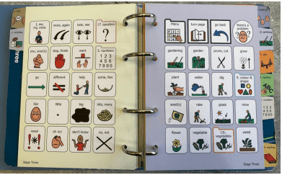
At Oaklands as well as Makaton, we use a range of Aided AAC to support pupils both paper based and powered based including talking tins, follow me boards, communication boards and books and electronic devices.
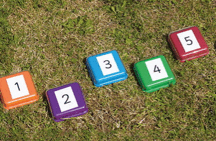
Attention Autism is an intervention model designed by Gina Davies, Specialist Speech and Language Therapist. It aims to develop natural and spontaneous communication through the use of visually based and highly motivating activities. It works to develop joint attention, a skill seen as essential in the development of language, social communication skills and learning. http://ginadavies.co.uk/
Aims of Attention Autism
- To engage attention
- To improve joint attention
- To develop shared enjoyment in group activities
- To increase attention in adult-led activities
- To encourage spontaneous interaction in a natural group setting
- To increase non-verbal and verbal communication through commenting
- To build a wealth and depth of vocabulary
- To have fun!
Stages of Attention Autism The AA programme progresses through a series of stages, building on each skill level. Each new stage is introduced when the group is ready to expand attention skills.
Stage 1: The Bucket to Focus Attention A bucket is filled with visually engaging objects and toys, aiming to gain the shared attention of the group. The adult leader shows each item to the group and uses simple repetitive vocabulary to comment on the various objects.
Stage 2: The Attention Builder Visually stimulating activities are shown to the group by the adult leader, aiming to sustain attention for a longer period. The activities are fun, visually engaging and can often involve delightful mess!
Stage 3: Turn taking & Re-engaging Attention The adult leader demonstrates a simple activity, often modelled with another adult in the group. Some children are then invited to have a turn but only if they are comfortable to do so. Not every child in the group will get a turn, which then teaches important emotional regulation skills, as well as the essential skills of waiting, turn-taking and learning through modelling.
Stage 4: Shifting & Re-engaging Attention Stage 4 aims to develop the skill of engaging and shifting attention. The adult leader demonstrates a simple creative task, and then gives each child an individual kit to copy the task. The children take their kits to a table, complete the task independently, and then everyone returns to the group to show their completed tasks.
More complex skills can be introduced as confidence and social skills develop e.g. sharing materials, working with a partner, problem solving. Attention Autism principles can then be generalised to curriculum activities (e.g. literacy and numeracy) to facilitate learning and skill development.
It’s all about getting connected. We want the children to be spontaneously interested in the world around them and that includes us! The Curiosity programme has 4 elements and they overlap.
- Get connected: This links closely to Intensive Interaction.
- Signature songs: Creating songs about every day activities and opportunities to engage the children in them.
- Creating curiosity: Children at this stage work through a specific sequence using a range of resources and containers as follows
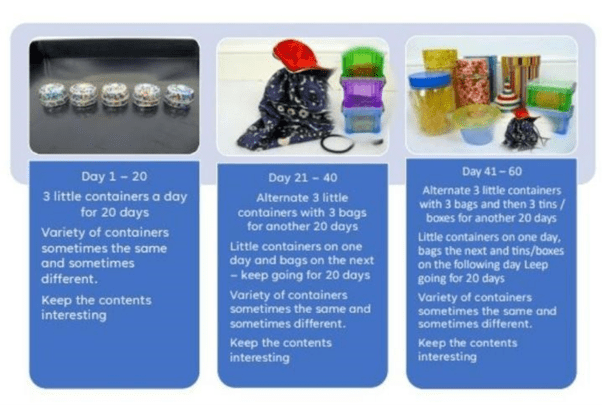
- Playing together: Neurotypical children play and so do autistic children it’s just their play looks different and has a tendency to be repetitive and circular. Our job is to bring meaningful, developmentally appropriate play opportunities to the child and create curiosity about them. Activities could include peepo, building and knocking down, sensory play, tickling games.
Teaches and develops the ‘Fundamentals of Communication’, attainments such as:
- Use and understanding of eye contacts
- Facial expressions
- Vocalisations leading to speech
- Taking turns in exchanges of conversation.
It works on early interaction abilities: how to enjoy being with other people, to relate, to know, to understand and practice communication routines.
Using Intensive Interaction (engaging attention through the use of body language)
Top tips:
- Empty yourself of your own agenda and enter the child’s world.
- Look for what your child’s body language is telling you has meaning for them, the physical feedback they are giving themselves, not just at what they are doing – but how they are doing it, since this will tell you how they are feeling. Watch the whole body rather than just the face.
- Tune in to the child with empathy using their ‘language’(noises/sounds/movements), with the aim of building up a ‘conversation’ and emotional engagement. Give them time to respond.
- Rather than mimicking and imitating them exactly, think of your answer as a response with very slight variations to attract their attention.
- Look out for negative responses (such as a flinch to light touch, moving away from you), which will indicate Hyper or Hypo sensitivities. Stop if you feel they don’t want you near them or carry on from a distance.
REMEMBER: The child leads the session NOT you. Therefore, it could happen anytime, anywhere.
The child will eventually know that when they make a sound or movement, they will get an answer.
Aloneness becomes shared interest
They show pleasure and want to interact.
Intensive Interaction videos and information:
https://www.youtube.com/watch?v=rjKxu6QKjAo
https://www.oxfordhealth.nhs.uk/oxtc/good-advice/intensive-interaction/
What is Makaton?
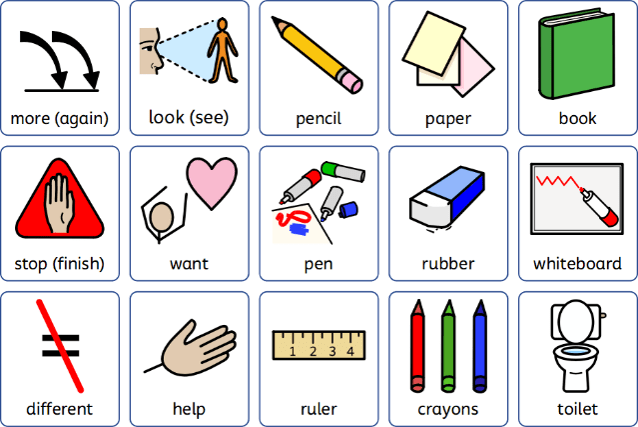
Makaton is a unique language programme that uses symbols, signs and speech to enable people to communicate. It supports the development of essential communication skills such as attention and listening, comprehension, memory, recall and organisation of language and expression.
Being able to communicate is one of the most important skills we need in life. Almost everything we do involves communication; everyday tasks such as learning at school, asking for food and drink, sorting out problems, making friends and having fun. These all rely on our ability to communicate with each other.
With Makaton, signs are used, with speech, in spoken word order. This helps provide extra clues about what someone is saying. Using signs can help people who have no speech or whose speech is unclear. Using symbols can help people who have limited speech and those who cannot, or prefer not to sign.
For those who have experienced the frustration of being unable to communicate meaningfully or effectively, Makaton really can help. Makaton takes away that frustration and enables individuals to connect with other people and the world around them. This opens up all kinds of possibilities.
Children learn best when they are having fun! Encouraging your child to take part in a range of different play activities will help them learn skills in social interaction, understanding of language, listening and problem solving. Children can then use these skills to help them understand and interact with the world around them. Play Interaction helps to teach positive social skills including:
- Sharing a space (accepting and tolerating contact with others
- Turn taking
- Being able to wait
- Co-operating
- Anticipating actions
- Giving eye contact
- Listening
- Attending to task
- Following and understanding rules for games.
- Developing language skills.
Pre-Verbal Children
At home and school, we can:
- Share their interest.
- Join your child in their world of play.
- Follow their lead in play and imitate their actions, vocalisations and play. You can use objects such as: blankets, ribbons, mirrors, feathers, bubbles, cause and effect toys (light, sound or movement) or a favourite toy or object
- Encourage eye contact.
- Build interest by introducing something new gradually.
- Enjoy and have fun!
Verbal Children
At home and school, we can teach positive social skills, being able to follow and understand rules of games and develop positive language skills through:
- Sharing a space (accepting and tolerating contact with others)
- Turn taking
- Being able to wait
- Co-operating
- Anticipating actions
- Giving eye contact
- Listening
- Attending to task
Visual Systems -Timetables
Visual supports are a communication tool that can be used with autistic people. They are particularly useful when creating visual timetable systems in classrooms. They can be used in most situations, are adaptable and can be portable. Visual timetable systems can help to:
- Provide structure and routine
- Encourage independence–they can be used to help pupils follow routines for dressing, making snacks, completing learning activities, managing their day etc.
- Build confidence
- Improve understanding
- Support transitions
- Avoid frustration and anxiety–when pupils are aware of their routine and what is coming next it helps to support self and co-regulation
- Provide opportunities to interact with others
- Motivation –pupils can see a reward on their timetable and are motivated to complete the activities leading up to the reward
- Behaviour management –certain preferred activities are visually scheduled at certain times of the day. This teaches pupils that they can do motivating activities, but only at certain times. It teaches them to look forward to something and can help to avoid challenging behaviour once understanding has been developed.
- Visual timetable systems can also be in calendar or checklist form to help warn pupils of and prepare them for changes in normal routine.
A wide range of items can be used to create visual timetable systems. For example:
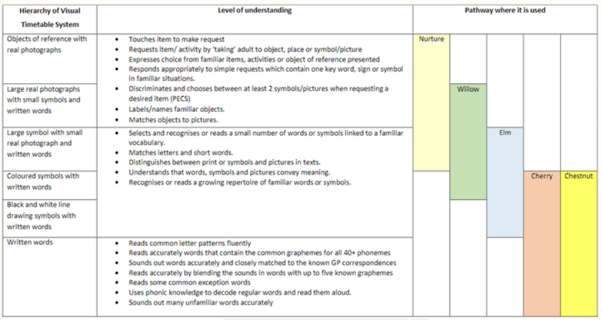
- Tactile symbols/objects of reference, e.g. Swimming trunks, packaging, food labels
- Photographs
- Short videos
- Miniatures of real objects
- Coloured pictures
- Plain squares of coloured card
- Line drawings
- Symbols
- Written words
Once past the first stage; images/symbols/written words can be physical or on a smartphone, tablet or computer. Pupils should be encouraged to engage with, assemble and change their own visual timetables, whichever form they take.
How are they displayed?
The classroom should have a main visual timetable for children to see. Individual visual timetables may look different for pupils at different stages of understanding:
- Now and next (2 objects of reference, photos or symbols)
- Now, next and then (3 objects of reference, photos or symbols)
- Sequence of 3 –5
- Separate morning and afternoon timetables
- Full daily timetable
Objects of Reference
Objects of Reference (OR) should be used to support understanding of timetables, structure and transitions. They should be used alongside real photographs and symbols in the first few stages of the visual timetable hierarchy. Pupils should be encouraged to take OR with them to new activities or locations to help them build associations. This is any time they begin something new on their timetable, so that they develop a deeper understanding of routines and recognition of timetable visuals. Modelling of the use of OR is essential to enable pupils to become more independent with changing and travelling with their OR. These skills will be transferred through the phases of the visual timetable hierarchy.
Now and Next Boards
Now and Next Boards are used when pupils are first introduced to visual timetables. Initially, they should have the photo/symbol on them along with the OR to build meaning association between OR and visuals. This progresses to just the photo/symbol visual when they no longer need the OR. Pupils should be encouraged to move the visual from ‘Next’ onto ‘Now’ when the first activity has finished, they should then add a new visual to ‘Next’. Modelling of reading the board should be given at all times e.g. “… has finished, next is…” (move visual) “so now it is time for…and next is…” (with pointing to the visuals). When starting the activity on ‘Now’, pupils should remove their OR or visual from the board and take it with them. Pupils can be extended to sequencing 3 visuals using a ‘Now, Next and Then’ board. Once pupils understand sequencing 3 visuals and can use the board correctly and independently, they should progress onto a visual timetable of up to 6visuals.This can show just their morning or afternoon schedule. Once pupils are using a longer visual timetable; the number of visuals they are sequencing should be incrementally increased until they are sequencing a full day. The aim is for pupils to show independent recognition of when a timetable activity has ended and for them to understand that this visual is removed from the timetable.
Transitions
When transitioning to a new activity or location in the first stages of using visual timetables, pupils should be encouraged to take their OR or visual off their Now and Next Board and match it to a large copy of the same visual at the activity location. Modelling of language and understanding is essential as pupils match their OR or visual e.g. “Now it is time for…” (and pointing to the large visual).